
What is an Apostille?
An Apostille is a simplified form of document legalization that applies to member states that have ratified the Hague Convention of 5 October 1961 Abolishing the Requirement of Legalisation for Foreign Public Documents. Armenia has been a member state of the Hague Convention since 1993.
In many countries, an Apostille is a special stamp. In Armenia, it is a special paper with the inscription APOSTILLE (CONVENTION DE LA HAYE DU 5 OCTOBRE 1961), which is attached with staples to the original or notarized copy of the document and sealed by the Ministry of Justice.
Previously, Apostilles in Armenia were issued in two languages: Armenian and English. Since July 22, 2017, they are issued only in English. In Russian, it is correct to say “Apostille” (not “Apostil” or “Apostile”) and “Hague Convention on Apostille” of October 5, 1961.
Although the official website of the Ministry of Justice of Armenia states “International legalization of documents (Apostille)” — this is a mistake. Because Apostille and legalization are somewhat different processes. Read about the “Legalization of documents” procedure here — >>>
What types of Apostilles exist?
This paragraph will be very useful for Armenian government officials.
There are three types of Apostilles:
1. A paper with the inscription APOSTILLE in the format established by the Hague Convention. This paper is attached to the document or stapled to the document itself and confirmed with a seal and signature of the responsible person. This type of Apostille is used in Armenia.
2. A seal or stamp APOSTILLE with a wet imprint. This type of Apostille is used in most CIS countries.
3. An electronic Apostille. This Apostille raises many unnecessary doubts and questions. The fact is that the practice of stamping documents with an Apostille did not justify itself. There were too many forgeries. Therefore, some countries decided to introduce an electronic register of Apostilles. For example, in the Republic of Moldova, the website of the Ministry of Justice of Moldova allows checking the authenticity of an Apostille and viewing its scanned copy.
This form of Apostille will soon spread worldwide as it ensures transparency and legality of the procedure and allows quick identification of both the Apostille and the document.
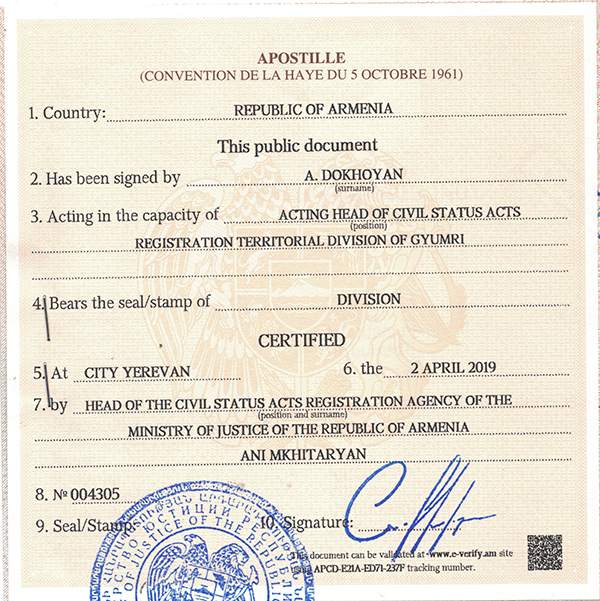
This Apostille was placed on a Birth Certificate
of the new format from Armenia in 2019
What is the purpose of an Apostille?
An Apostille confirms the authenticity of the signature of the official or employee who signed the document. The Apostille does not confirm the content of the document. The official whose signature is certified by the Apostille is responsible for the content of the document. In turn, the Apostille is signed by another official. The Apostille also confirms the authenticity of the seal on the document.
Before the Apostille Convention, documents had to undergo a complex legalization procedure. This procedure remains for documents from countries that are not members of the Apostille Convention.
Which documents can receive an Apostille?
The Ministry of Justice of the Republic of Armenia applies Apostilles to the following documents:
1. documents or copies of documents, on language translations, notarized, on certificates and statements issued by a notary (Law “On Notaries”),
2. on birth, death, and marriage certificates issued by the civil registry offices of Armenia,
3. on documents issued by the judicial enforcement service,
4. on documents issued by judicial authorities (court decisions, copies of court decisions, and other documents),
5. documents from other bodies and organizations if the authenticity of the signature on them is certified by a notary.
For which countries is an Apostille applicable (needed)?
You can find the full current list of countries that are members of the Apostille Convention at this link>>
However, keep in mind that if countries have signed the Apostille Convention, it does not mean that an Apostille is required in every case. There are also countries that are members of the Apostille Convention but have signed additional bilateral agreements simplifying the recognition of certain documents.
If countries that have signed the Apostille Convention have also signed an Agreement on Simplified Recognition of Documents between themselves, then the requirement for an Apostille in one of these countries is unlawful. Although officials of these countries sometimes still require an Apostille.
There are also exceptions where a country does not recognize the Apostille of another country. For example, according to Wikipedia, the Armenian Apostille is not recognized in Kosovo. Conversely, the Kosovo Apostille is not recognized in Armenia.
An Apostille is not placed on documents intended for use in CIS countries, regardless of the authority, department, or ministry.
CIS countries have signed the Minsk Convention “On Legal Assistance and Legal Relations in Civil, Family, and Criminal Matters” of January 22, 1993.
The Republic of Armenia has agreements on document recognition with countries such as Bulgaria, Lithuania, and several others, as provided by international treaties of the Republic of Armenia.
If a country is not a member of the Hague Convention and has not signed the relevant interstate agreement, consular legalization of documents is performed.
Where can you get an Apostille?
An Apostille can be obtained at the Civil Status Registration Agency of the Ministry of Justice of the Republic of Armenia.
If you cannot or do not wish to apply to the Ministry of Justice of Armenia yourself, you can contact our company.
Our company offers Apostille (recognition) services for documents of the new format approved in Armenia.
What documents are needed for an Apostille?
For an Apostille at the Ministry, the following are required:
1. an application, full name, address, phone number, and names of the documents submitted for Apostille;
2. the document itself;
3. a photocopy or copy of the document submitted for Apostille;
4. a receipt for payment of the state fee.
Processing time for an Apostille
Under standard processing, an Apostille is issued within two working days from the date of submission of the application and the document.
If expedited service is requested and paid for, it can be done in one working day.
If there are doubts about the authenticity of any documents, the processing time may be extended to fifteen working days. In this case, a written response about the extension is issued within one day, stating the reason for the extension and signed by the responsible person.
How to verify an Apostille?
Currently, there is a special resource where you can verify the validity of an Apostille. The website is the Electronic Register of Apostilles of the